
Refractive Errors
Refractive errors are a category of eye conditions which cause blurred vision due to a defect in the natural shape of the eye impairing the individual’s ability to see clearly. It is the most common condition seen in the ophthalmology department, where a defect in the shape of the eye prevents the light from focusing correctly on the retina – a light-sensitive layer of tissue in the back of your eye. Optical correction using glasses or contact lenses is a common treatment apart from refractive surgery.
Myopia
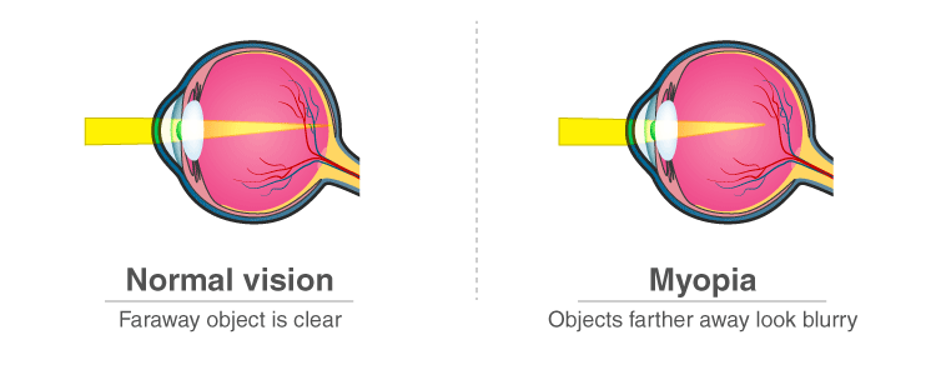
It is also known as near-sightedness or short-sightedness, is an eye disease where light from distant objects focuses in front, instead of on the retina reducing the focal length for vision. As a result, distant objects appear blurry while close objects appear normal.
This defect occurs when eyeball length is too long and can be hereditary with the features becoming more pronounced in adulthood. Squinting and blurred vision in long sight along with fatigue and severe episodes of headaches are a common feature of this condition. This defect can be corrected by using a concave lens of appropriate power. Eye-glasses with diverging lenses decrease the focusing power required for forming the image on the retina.
Hypermetropia
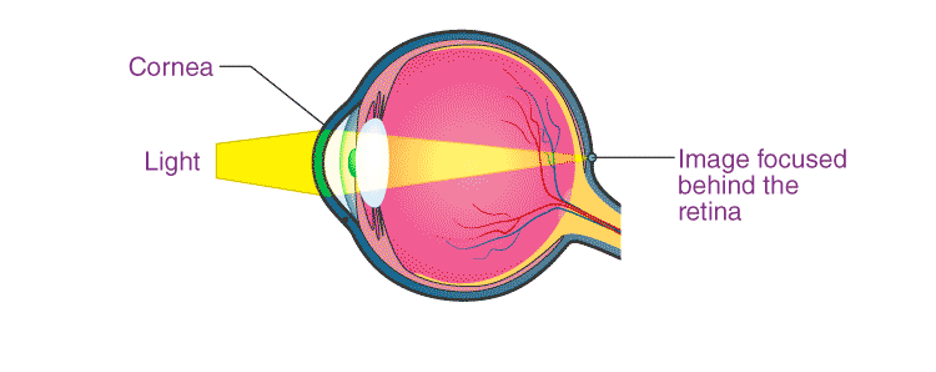
Far-sightedness, also known as long-sightedness or hyperopia, is a condition of the eye where distant objects are seen clearly but near objects appear blurred. This defect arises either because (i) the focal length of the eye lens is too long or (ii) the eyeball has become too small. That is, incoming light gets focused behind instead of the retina due to insufficient accommodation by the lens.
This defect can be corrected using a convex lens of appropriate power. Eye-glasses with converging lenses provide the additional focusing power required for forming the image on the retina.
Astigmatism
Astigmatism is a type of refractive error where the front part of your eye, the cornea is not completely round and is shaped irregularly inhibiting vision. Astigmatism occurs when the cornea or lens of one eye is curved more steeply in one direction than in another making the vision to be more blurry and wavy as the light rays do not refract (or bend) properly when they meet the cornea. Vision is blurry at near and far because light rays either fall short of the retina or behind it.
An error in the rotational symmetry of the eyes refractive power, Astigmatism commonly occurs alongside two other types of refractive errors namely nearsightedness (myopia) where object near to the eye seem blurry and farsightedness (hyperopia) where distant vision is impaired. A largely asyptomatic condition, when unnoticed over time can present symptoms like headaches, eyes strain, fatigue apart from blurred eyesight.